Current Crop Condition
Most of August was very hot and dry in most parts of the state. Rain has been infrequent and sporadic, although some areas may have received enough rain throughout the period, or were, at least, less impacted by drought. Hot and dry weather typically causes several potential upper young bolls to shed, and the plant will temporarily cease blooming altogether, especially if there is a heavy boll load. In most areas, this is a very common scenario. This typically accelerates crop maturity, as the remaining bolls are relatively larger and more mature than normal at this point. Similarly, there was more April-planted cotton this year than normal. Boll opening began during the last week of August and will become more prevalent in the coming weeks. As of right now, the forecast appears to be relatively warm with low but sporadic chances of rain over the next couple of weeks. Why is any of this important? This impacts us in a couple of ways: the crop is or will likely be ready for defoliation noticeably earlier than normal, and we should be ready to address regrowth. In some cases, the crop is ready to be defoliated now, but only thorough evaluation of the unopened bolls will dictate when defoliation can begin.
Defoliation Timing
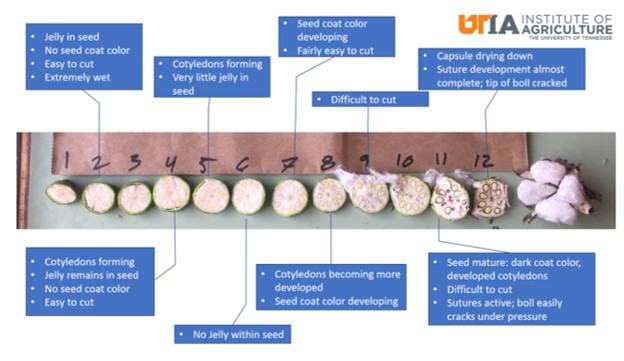
Typically, a crop that has reached 60% opened bolls, and 4 nodes above cracked boll can be defoliated. The big underlying assumption with these rules of thumb is that the unopened bolls are mature enough to where they will safely open if defoliation were to occur. However, there are exceptions to these rules, where the unopened bolls are not quite mature enough for defoliation, and we see them nearly every year. The safest way to determine if boll maturity is ready for defoliation is to slice the uppermost harvestable bolls and evaluate the seed and lint inside. Once the seed are well developed and start forming a distinct and darker seed coat, defoliation can occur without compromising the opening of these bolls. Such bolls should be difficult to slice, and lint should string out when doing so. Below is an illustration of boll maturity developed a few years ago by our counterpart in Tennessee. Using this illustration, once the uppermost harvestable bolls reach maturity of an “8” or “9” in the below illustration, defoliation can be initiated and these bolls will likely open safely. Bolls with a higher level of maturity will likely open more rapidly, however maturity of at least an “8” or “9” should open without complication under normal conditions and tankmixtures.
'
Defoliation Timeliness (Different from Defoliation Timing)
With regard to “timeliness” of defoliation, this is an area that we could probably improve upon. In some years, the crop is ready before we are, and this year will likely be one of those years. In the peanut producing areas of the state, naturally those growers will focus their attention on peanuts first and deal with cotton later. However, with baler pickers, we have the opportunity to address both in a timely manner. There have been years in the past where cotton could’ve been defoliated much earlier than it was. Likewise, harvest could’ve been conducted earlier. In some cases, defoliation was delayed until late September or early October, due to attention diverted to peanuts or simply because we were prepared for harvest. In some of those instances, tropical or otherwise adverse weather (cloudy, cooler, wet weather that caused hardlocking etc) took away some yield potential or degraded quality, whereas an earlier harvest could’ve preserved that yield potential, had we defoliated as soon as the crop was ready.
DON'T defoliate more than you can effectively harvest 2 to 2.5 weeks later. It does no good in terms of yield or quality to leave cotton fully exposed longer than necessary. Quality of any given boll will be the best that it’ll be the day it opens. Beyond that point, quality can remain the same or decline. The more weather it encounters, the more rapidly and severely it will decline. The same applies to yield contribution of any given boll. The more rain or wind that an open boll encounters, the more likely lint will be lost or lose weight. Defoliating as soon as fields are ready, and continuing defoliation in a sequence that follows crop maturity, allows for timely harvest to follow. This rule should be followed until mid October, which is discussed below.
Try to get as much done in October as possible. For several years, we have said that it pays less and less to delay defoliation beyond mid October. Recent research has clearly confirmed that. Usually, we dont accumulate many more meaningful heat units beyond mid October in most years, therefore waiting on bolls to mature beyond mid October will require a noticeably longer time, and they still may not open. Recent research has clearly illustrated that it is better to defoliate by mid October, which allows a couple of weeks of time and the last remaining heat units before our average first frost date (late October through early November), which therefore allows our boll openers to perform. This research also illustrated that delaying defoliation until just before a frost doesn’t allow adequate time or heat for boll openers to perform ideally, therefore the probability of opening later set bolls is actually less if we delay defoliation beyond mid October. Although most of us are not likely chasing a top crop this year, this research is still important because it tells us that we should defoliate all last remaining fields by mid October, as the odds of opening bolls adequately are greater compared to delaying defoliation further into the Fall. If we have been timely with defoliation all along, there shouldn’t be many acres remaining by mid October. On a similar note, once November arrives, drying time of rainfall noticeably increases, our effective harvest hours per day decreases, and lint weight begins to decline after multiple frosts or rains. We can generally achieve alot more by targeting defoliation as soon as the crop is ready and harvest in October, within reason, and when given the opportunity.
Optimizing Defoliation
Try to target defoliation on days with ample sunshine, followed by another day of sunny weather. In the past, it has often been observed that defoliating on cloudy days will most likely lead to poor defoliation, requiring a 2nd attempt to completely remove leaves and open bolls. Regardless of the tankmix used, you can expect more complete and overall better defoliation when spraying on a sunny day, especially if followed by another sunny day. Use 20 GPA (no less than 15 GPA) on ground sprayers, and avoid large-droplet tips. A good flatfan or twinfan nozzle, capable of applying the appropriate carrier volume, offers a mixture of fine to course droplets and usually improves coverage
Avoid defoliating when wet conditions are expected for more than a couple of days. When bolls pop open, the burrs simply need to dry out in order to properly retract and expose seedcotton for harvest. When burrs can not dry out due to wet conditions, they can not retract, therefore resulting in hardlocked bolls, which tend to be lost.
Although this isn’t on our radar yet, it is still worth mentioning. If a Tropical storm approaches us, and you still have unopened bolls, DON'T DEFOLIATE unless you can reasonably harvest those fields before the storm hits. In most cases, we dont have much certainty of a storm's likely path that far in advance. The only reasonable case for defoliating before a storm is when nearly all bolls are open, the few remaining closed bolls are very mature, AND you can harvest it before a storm hits. Otherwise, DONT DEFOLIATE. Everyone worries that they'll get behind if they dont go ahead and defoliate, but staying on time does us no good if our bolls are hardlocked (partially open when a storm hits) or lost due to intense winds and rain (fully open when a storm hits). Remember, closed bolls are protected bolls, and past years have made it clear that defoliating in sunnier conditions after a storm has passed preserves a noticeably greater amount of our yield potential.
Tankmixtures to Consider (and this is NOT an exclusive list)
Given the current crop status for most of the state, and the current forecast, some of this crop will be ready for defoliation very soon. Likewise, we should expect regrowth to some degree. A hot, dry August that has shed all of it’s younger bolls, especially one that already has opened bolls, has met the demands of its boll load, or it will soon. This means that if there is any moisture available at all, the crop has little to no demands to fill and will therefore cycle around and generate new vegetative growth, I.E. regrowth. So even though there isn't much visible now, a little rain can easily trigger it once we defoliate, so be prepared to address it. Defoliation will also allow light to contact those lower buds which will also trigger regrowth.
The current forecast has us in the low 90’s for the next few days, the mid to high 80’s or very low 90’s next week, and low to mid 80’s during the week following. Nighttime lows are expected to be in the low 70’s for the next few nights, and low to mid 60’s for a while after. temperatures are expected to be in the mid to upper 80's with nighttime lows well into the 60's. Avoid defoliating when temperatures are in the 90’s, especially if there is high humidity. No tankmix is safe in those temperatures, and although unpredictable, there is a real risk of severe desiccation with any tankmixture when temperatures are this high. Once we have highs in the 80’s and lows in the 60’s, tankmixtures that utilize TDZ (Dropp, FreeFall, others) can be very effective for addressing regrowth in these temperatures. A couple of common tankmixtures that come to mind include:
Finish 1 qt/A (can add up to 10 oz ethephon for enhanced boll opening) + Folex 4-6 oz/A + TDZ 3.2 oz/A
- or -
Folex 10-12 oz/A (8 oz/A if in the very high 80’s or low 90’s) + ethephon 32-42 oz/A + TDZ 3.2 oz/A
- or -
TDZ+diuron 8 oz/A + ethephon 32-42 oz/A
Given the accelerated maturity most early planted cotton is, and how progressed boll opening has been, the Finish tankmixture may not be necessary for the next couple of weeks with warmer temperatures, but it will certainly still be effective. In warmer conditions, this tankmixture can accelerate boll opening so that harvest can occur sooner, so be sure to take advantage of those few extra days if you decide to use this tankmixture. For example: At 7-10 days after defoliation, the Finish tankmixture will likely have an advantage for boll opening, however, by 14 days after defoliation, we would expect boll opening of a mature crop to be very similar between these two tankmixtures. When cooler temperatures arrive, and/or you have fields that received timely rains and therefore have a younger top crop, the Finish tankmixture will often have an advantage.
Likewise, the TDZ+diuron mixture listed above may not be necessary to address regrowth when weather is warm, but is still effective at regrowth control and overall defoliation when highs are in the 80’s and lows in the 60’s. Avoid this mixture when highs are in the very high 80’s or low 90’s for several days, especially in high humidity. Once temperatures cool, this tankmixture will become more necessary to properly address regrowth.
If temperatures fall into the 70's for highs, and lows in the 50's, for the early planted, or otherwise very mature cotton, regular ethephon tankmixtures will likely remain to be effective for boll opening. If there are any fields with somewhat less mature upper bolls (later planted, irrigated, or happened to have rainfall since late August), or if you are anxious to harvest a little sooner, a Finish-based tankmixture is likely to be more appropriate in those temperatures. Likewise, when days are relatively cool and nighttime lows are down into the 50's consistently (especially below 55 degrees for several days), TDZ may not be sufficient for addressing regrowth. Therefore, switching to a TDZ+diuron mixture (Ginstar, Adios, CutOut, others) may be needed to adequately address both defoliation and regrowth control. TDZ will still have activity in those temperatures but it will be noticeably slower, and if any rains trigger regrowth, it may be insufficient. Tankmixtures that come to mind for this scenario might include the following:
Finish 1 qt/A (can add up to 10 oz ethephon for enhanced boll opening) + TDZ+diuron 6.4 oz/A (can increase the rate to 8 oz in colder weather)
- or -
TDZ+diuron 8 oz/A (can increase the rate to 10 oz in colder weather) + ethephon 32-42 oz/A
This is not an exclusive list of tankmixtures, but merely a short list of some common tankmixtures that apply to a broad range of conditions. There are others that may be effective or could address crop needs that aren’t discussed here. Call your county agent, consultant, or us, so that we can walk you through the best approach.