As predicted in a previous article, colonization of our earliest planted cotton by thrips is light at this point. Thrips are in the system and colonizing, but we have yet to experience the heavy flights from third and fourth generation tobacco thrips. They will show up. Dr. Ames Herbert has been monitoring volunteer peanuts in Suffolk, VA, which are loaded with tobacco thrips. This means that cotton planted now (mid-May) and on into June will probably be at risk for the heaviest thrips colonization events. You can protect your cotton by applying a foliar overspray of acephate at the first true leaf stage, even if you used an insecticidal seed treatment. Also, since resistance to insecticidal seed treatments has been detected in the Midsouth (not in the Southeast), this will provide us a good way to delay resistance, since we are applying a different type of chemistry to the plant as a spray.
Cotton Thrips Update
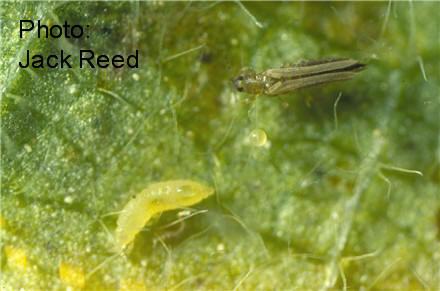
With that in mind, we still need to protect our earliest planted cotton with a foliar overspray, as well. Plant growth has probably slowed with this stretch of dry weather and cooling conditions might hamper this some more. If Admire Pro was applied in-furrow with an insecticidal seed treatment, I would suggest scouting the cotton to see if larval thrips populations are developing. You should scout several places in the field and pull up at least 10 plants in these places, carefully inspecting the bottom leaves for adults and larvae. Sprays should not be based on adults, as these are the colonizers. Wait to spray until you notice two larval thrips per seedling. Hopefully, as has been shown in replicated studies, fields planted with an insecticidal seed treatment and Admire Pro in furrow will not require a foliar overspray. However, until we get a year or two under our belt, we won't know how effective this tactic is over a widespread area.