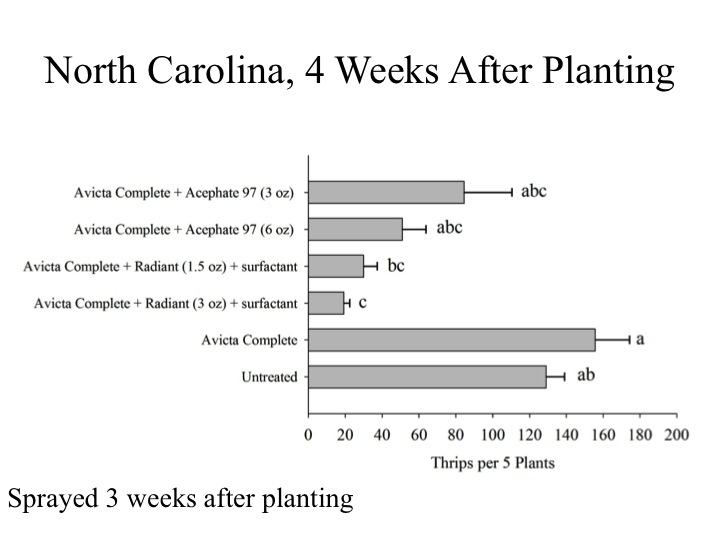
I had a chance to scout some more cotton this week and it looks like numbers are picking up a bit, but are still underwhelming compared to this time in previous years. We can expect more thrips to invade our cotton and develop as time goes on. With most of the cotton in the ground and up, we need to focus on managing thrips with foliar sprays.
One grower field that I visited today was planted 2-3 weeks ago and was starting to show some injury on the first true emerging leaf. This is not surprising since the best we can expect from a seed treatment is 3 weeks of protection. With heavy rainfall, we can expect some of the chemical to wash away from the seed without being taken up from the plant. Note that many years of replicated trials in North Carolina have not shown a consistent advantage to one seed treatment over another. However averages can be deceiving, especially in a non-average year. Your choice of seed treatment could be important here, since thiamethoxam is eight times more soluble in water than imidacloprid. Most entomologists across the Southeast agree that a spray timed at the first true leaf (1/4 inch long- photo in this article) is more effective than later sprays. The field I visited today could probably benefit from a foliar overspray.
It is tempting to tank mix sprays for thrips with a trip for herbicides. This can work if your timing is right for thrips and if your mix is compatible (see this tank mix article). If you have palmer problems, you probably have a really good pre-emergent down and you might be a little late for good thrips management. Consider an earlier trip across the field for thrips if it looks like you're at threshold (two larval thrips per seedling).