With cotton squaring and flowering weeks away, it is a good idea to think about treatment options for plant bugs. In fact, some growers have already confirmed square loss from plant bugs and densities of plant bugs above threshold in our state. Some fields have already been sprayed, as a result, and it is a good idea to be prepared. Although I think plant bugs are going to be an issue this year, I also think that we can easily manage them if we scout our fields correctly. What I hope we can avoid is spraying when we don't need to, which can lead to resistance or flare other pests later in the season. For example, no insecticide will control adults that remigrate into a field after a spray or stop squares that are being shed from droughty conditions with no plant bugs present. Consult this article for scouting information.
Insecticides for Plant Bugs
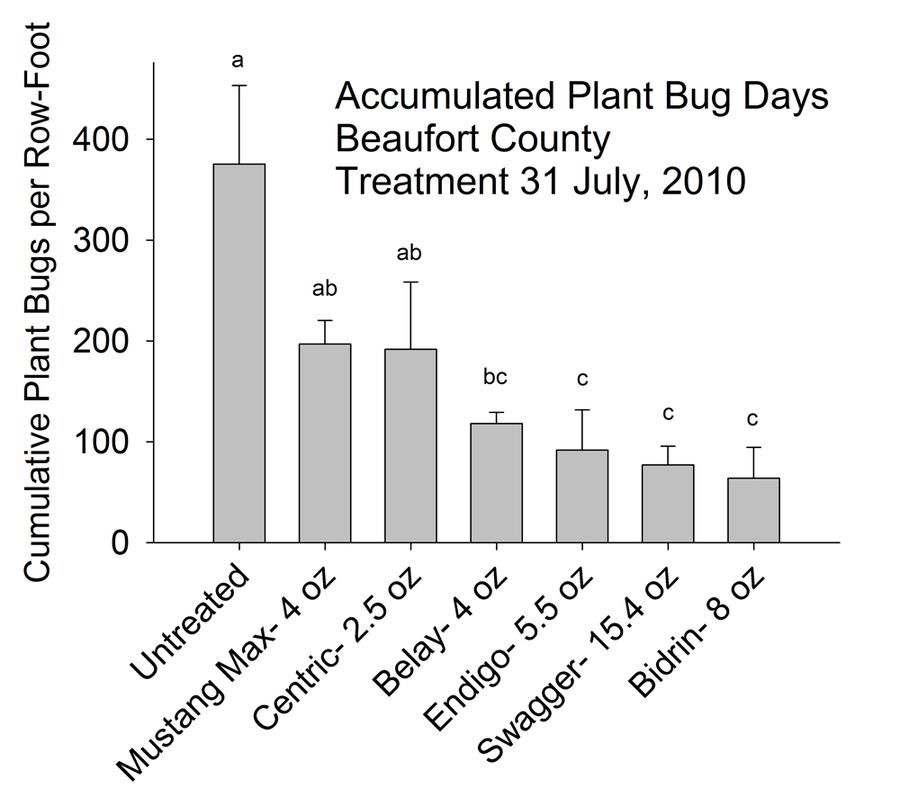
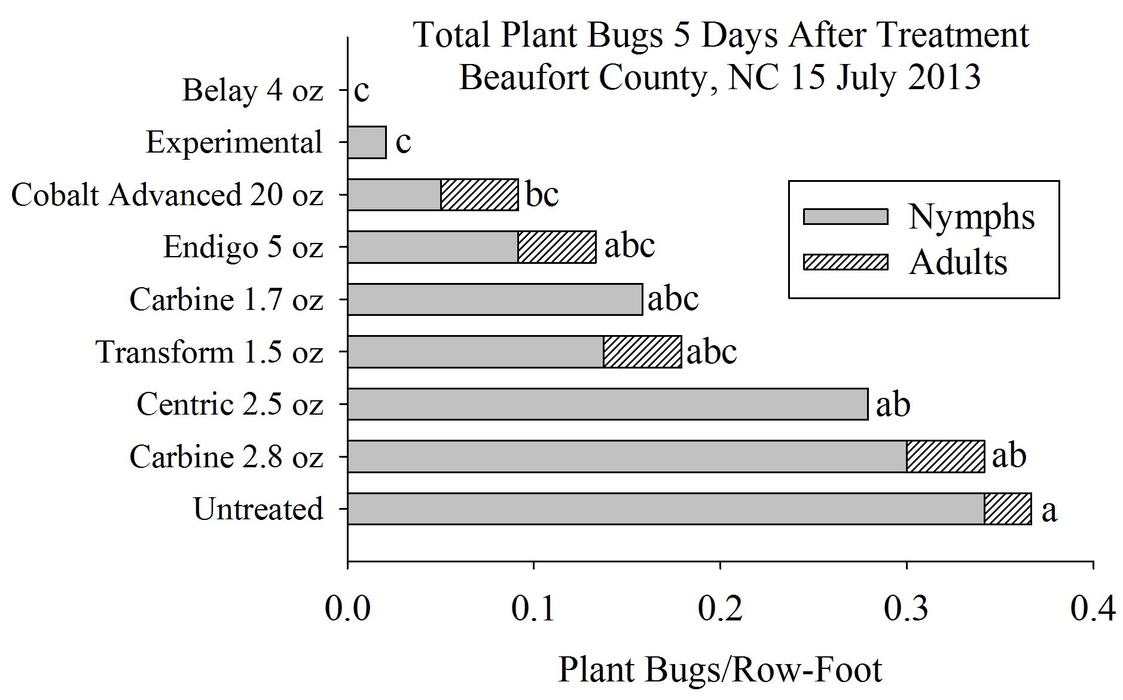
Generally the neonicotinoid-class insecticides perform well early in the season before flowering and often at lower rates. These include products such as Admire Pro, Belay, Centric, Intruder, Trimax Pro, etc. The advantage to using these products is that they generally do not flare secondary pests, such as spider mites, and may preserve some, but not all, beneficial insects. In general, a product that is killing a plant bug will likely kill related beneficial insects such as minute pirate bug and insidious flower bug, damsel bugs, assassin bugs, and big-eyed bugs. However, these products are still much less harsh on the system than pyrethroid and organophosphate-class insecticides.
Later on in the season, neonicotinoid insecticides generally do not work as well. However, Belay performed well in 2010 and 2013 trials that I had well into the growing season. That being said, I am recommending that you do not spray a pure neonicotinoid product more than once a season (common examples of Admire Pro, Belay, Centric, Intruder, Trimax Pro are listed above) or a mixed product more than twice a season (common examples include Brigadier, Endigo, and Leverage 360). Aphid resistance to neonicotinoids is on the rise and was confirmed in eastern NC in 2012. All cotton seed treatments targeting thrips are neonicotinoids and pre-mixed product use in cotton is widespread. Hence, the increase in neonicotinoids in cotton is increasing aphid resistance to these products. Therefore, to counteract this resistance I am recommending that you rotate insecticides.
Also keep in mind that there are label restrictions to how much insecticide can be used throughout the season. One example is thiamethoxam. The maximum amount of this chemical that can be sprayed in the season is equal to a 5 oz rate of Centric (0.125 lb active ingredient per acre). That total amount includes premixed products that contain thiamethoxam, such as Endigo. Check the label before you spray to see what the active ingredients are and how much can be applied to the crop.
Here is an example of a spray plan. For the first plant bug spray pre-bloom, at squaring or first flower, consider using a stand-alone neonicotinoid product (common examples include Admire Pro, Belay, Centric, Intruder, Trimax Pro). If plant bugs are still a concern later on, or require a second spray, first check to see that aphids are not common in the field. If they are, you should not use a neonicotinoid again. Switch to a product like Carbine, Transform, or one of the more effective pyrethroids. Remember that aphids first occur in field “hot-spots”. So you might not see a population and resistance developing until it is full-blown. Be sure to scout these fields intensively. If aphids are not a concern, you should still not use a stand-alone neonicotinoid product for a second spray, but should switch to one of the pre-mixed products (like Endigo, Swagger, etc.) or an organophosphate/carbamate-only product (Bidrin, Orthene, Vydate, etc.). Many of these products are also effective against stink bugs; eliminating stink bugs can be beneficial during the period of boll formation. The downside to these products is that they kill beneficial insects and put you at risk for bollworm and spider mites.